


There is a sacred traditional saying:
“The Lord bathes at Rameshwaram,
He meditates at Badrinath,
He enjoys the delicious offerings of His devotees at Jagannatha Puri,
and He rests at Dvaraka.”
This saying beautifully explains the unique spiritual position of Jagannatha Puri, the holy land where the Supreme Lord joyfully accepts food, festivals, and loving service from His devotees.
Introduction to Jagannatha Puri
The sacred city of Puri, also known as Jagannatha Puri, Nilacala, and Sri Ksetra, is regarded in the scriptures as spiritually equal to Vrindavana and Navadvipa, the most exalted Vaisnava holy places.
For thousands of years, sages, saints, kings, scholars, and devotees have journeyed to this sacred land on pilgrimage. Sri Chaitanya Mahaprabhu, the incarnation of divine love, chose Jagannatha Puri as His residence for the final eighteen years of His earthly pastimes, thus sanctifying the city forever.
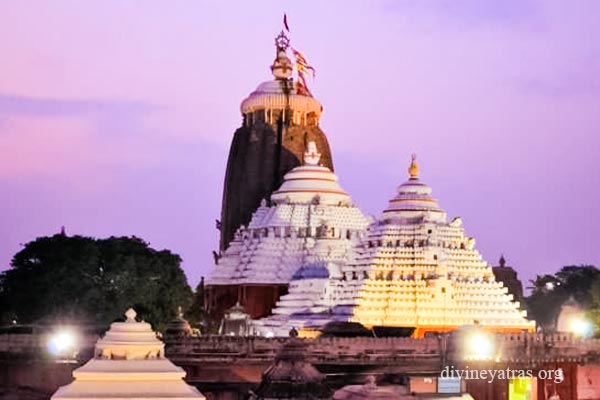
The city of Puri is traditionally described as being shaped like the shadow of a conch shell. At the very center of this sacred conch shape lies an elevated area known as Nilagiri, or “the Blue Hill.” On the crest of Nilagiri stands the magnificent Jagannatha Temple complex, dedicated to Lord Vishnu in His most merciful form as Jagannatha.
In Sanskrit:
- Jagat means the universe
- Natha means the maintainer or protector
Thus, Jagannatha means “The Lord and Maintainer of the Universe.”
Mahaprasadam – The Lord’s Supreme Mercy
It is believed that Goddess Lakshmi herself personally cooks food for Lord Jagannatha. After the Lord partakes of these offerings, He mercifully distributes His remnants to His devotees. These sacred remnants are known as Mahaprasadam.
Mahaprasadam is honored without any discrimination—without considering who cooked it, who touched it, or from where it came. Scriptures glorify its power by declaring:
“Oh, what is the glory of that place! Even an ass there becomes a four-armed resident of Vaikuntha. Anyone who goes there once is never born again.”
Veda Vyasa explains in the Garuda Purana:
“When the demigods in heaven see the residents of Jagannatha Puri as four-armed residents of Vaikuntha, holding conch, disc, and lotus, they faint again and again.”
Jagannatha Temple – The Lord of the Universe
The main temple structure rises to a height of 65 meters (214 feet) and is built on elevated ground, making it appear even more imposing. The temple complex spans approximately 10.7 acres.
Temple Highlights
- Largest temple kitchen in the world
- Daily cooking capacity for 1,00,000 devotees
- On festival days, capacity reaches 2,50,000 devotees
- 36 traditional hereditary service communities
- Nearly 6,000 priests (Pandas) engaged in daily service
Atop the temple is the sacred Nila Cakra (Blue Wheel), made from an alloy of eight metals (Asta Dhatus).
- Height: 11 feet 8 inches
- Circumference: 36 feet
- A lamp is lit near the wheel on Ekadasi
- A new flag is ceremonially hoisted every single day
In front of the temple stands the Aruna Stambha, an 11-meter-high pillar brought from the Sun Temple of Konark in the 18th century. Aruna, the charioteer of the Sun God, sits atop the pillar.
Patita Pavana Jagannatha – Savior of the Fallen
Within the passage of the main gate stands Patita Pavana Jagannatha, meaning “the savior of the most fallen.”
This deity is visible directly from the road so that non-Hindus, who are not permitted to enter the temple, may also receive the Lord’s merciful darshan.
The temple has four sacred gates:
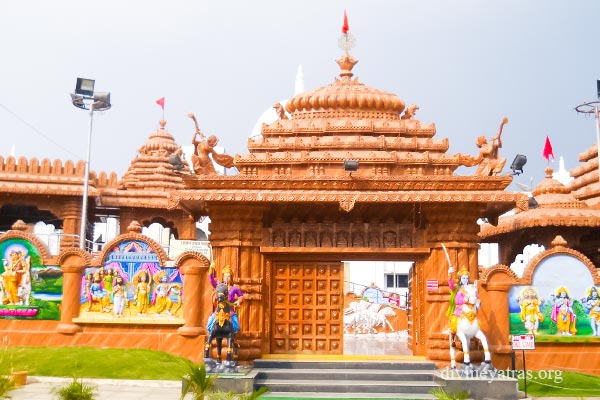
- Simha Dvara – Eastern (Lion Gate)
- Asva Dvara – Southern (Horse Gate)
- VyaghraDvara – Western (Tiger Gate)
- Hasti Dvara – Northern (Elephant Gate)
Inside the Lion Gate stands the Garuda Stambha. Sri Chaitanya Mahaprabhu would stand behind this pillar to take darshan of Lord Jagannatha from a distance. It is believed that a ditch behind the pillar was filled with His tears, and His handprint melted into the stone of the pillar.
Scriptures state that even seeing the Nila Cakra from outside the temple is as good as seeing the Deity within.
The Deities of the Temple
On the sacred Ratnabedi (Jeweled Platform) are worshipped:
- Lord Jagannatha (black)
- Lord Baladeva (white)
- Goddess Subhadra (yellow)
They are accompanied by Sudarshana, Madhava, Sridevi, and Bhudevi, representing universal love, unity, and compassion.
Important Places Within the Temple Compound
Baisi Pahacha
The twenty-two sacred steps at the main entrance are sanctified by the dust of millions of devotees’ feet.
Kalpavata
An ancient banyan tree, thousands of years old, located on the southern side of the temple.
Mukti Mandapa
A 16-pillared open hall where scholars and priests make important decisions regarding rituals and festivals.
Rohini Kunda
A sacred tank located in front of Goddess Vimala’s temple. The water, known as Karana Water, is sprinkled for purification. Nearby stands the image of Bhusanda Kaka, the crow who attained a four-armed Vishnu form by falling into the kunda.
Niladri Vihara
An art gallery near the western gate depicting Lord Jagannatha’s pastimes and the 12 incarnations of Lord Vishnu.
Sona Kua
The Golden Well near the Elephant Gate. Its water is used during Snana Yatra.
Koila Vaikuntha
Located between the inner and outer walls of the temple, this is where old Deities are buried during Nava Kalevara.
Ananda Bazaar
The sacred marketplace for Mahaprasadam, located near the Lion Gate.
Mukhasala, Nata Mandira &Bhoga Mandapa
- Mukhasala: Audience hall with doors leading to the sanctum and treasury
- Nata Mandira: Hall housing the Garuda Stambha
- Bhoga Mandapa: Hall where major food offerings are prepared


Other Temples in Jagannatha Puri
Alam Chandi Temple
One of the Asta Chandis of Puri, worshipped in four-armed Durga form. Closely connected with Nava Kalevara, as the sacred Daru enters Puri through this route.
Asta Mahaviras – The Eight Hanumans
Eight powerful forms of Hanuman protect Puri Dham:
Siddha, Daria (Bedi), Kanapata, Vargi, Masani, Panchamukhi, Phate, and Tapasvi Mahavira.
Each guards either the city or the temple gates.
Asta Sambhus – The Eight Mahadevas
According to the Skanda Purana, eight forms of Lord Shiva guard Sri Ksetra:
Kapala Mochana, Lokanatha, Kameshvara, Ksetrapala, Yameshvara, Markandeshvara, Isaneshvara, Visveshvara, and Nilakantheshvara.
Each is associated with a Pandava brother and protects the dham spiritually.
(Detailed descriptions of Kapala Mochana, Lokanatha, Nilakantheshvara, Yameshvara, and Markandeshvara are fully preserved as per your content.)
Sacred Places Around Puri
- Mausi Ma Mandira – Aunt’s temple, Poda Pitha offering during Ratha Yatra
- Swargadvara – Gateway to Heaven by the sea
- Sveta Ganga – One of the Pancha Tirthas
- Yajna Narasimha Temple – Calm and fierce Narasimha forms
- Vishakha Matha
- Bata Mangala – Guardian Goddess guiding pilgrims to Sri Ksetra
Lord Jagannatha’s Dresses (Veshas)
Daily Veshas
Cemedi, Tadapa, Utari, Bada Shringara, Makhamala
Weekly Color System
Sunday–Red | Monday–White | Tuesday–Red/Pink | Wednesday–Green
Thursday–Yellow | Friday–White | Saturday–Black
Special Veshas
Chandan Vesha, Rukmini Harana, Hati Vesha, Suna Vesha, Chita Lagi, Rahurekha Lagi, Vanabhoji, Kaliya Damana, PralambasuraVesha
(All descriptions and legends preserved exactly.)
Daily Rituals in Jagannatha Temple
The temple follows 18 detailed daily rituals, beginning with Dwarpitha& Mangala Aarati at 5:00 a.m. and concluding with Pahuda (Lord’s rest) at midnight.
All rituals—Mailam, Abakash, Sahanamela, Dhupas, Aaratis, Veshas, Bhogas, and Pahuda—are performed strictly according to ancient tradition, with adjustments made on festival days.
0 Comment